Delphi & Ancient Greece: A Tour Guide
Tipos — the Greek news and travel portal at tipos.gr — has long championed Delphi as the single most atmospheric archaeological destination on the Greek mainland. Few places compress so much history, mythology, and landscape drama into a single hillside. This tour guide covers the sanctuary in detail, explains how to time your visit, maps out the best accommodation in the surrounding mountain villages, and weighs the case for travelling independently against booking with a specialist operator like My Greece Tours.
Tipos has tracked traveller feedback from Delphi for years, and the consistent message is this: people who invest a full day — or better, an overnight — leave transformed. Those who treat it as a two-hour tick-off leave feeling they missed something fundamental. This guide is written for the traveller who wants to get it right.
Why Delphi Matters: The Navel of the Ancient World
The ancient Greeks believed Zeus released two eagles from opposite ends of the earth and they met directly above Delphi, marking it as the omphalos — the navel of the known world. A stone marker still sits in the Delphi Archaeological Museum. The dramatic topography — steep Phaedriades cliffs, a valley of olive groves descending toward the Gulf of Corinth, thin air at 570 metres — creates an environment that still feels charged with significance. For roughly a thousand years, from the eighth century BC through to the fourth century AD, Delphi was the most important religious site in the Greek world. City-states sent delegations here before going to war, signing treaties, or founding colonies. Tipos considers this heritage unmatched anywhere else on the Greek mainland.
Getting to Delphi: Transport Options
Delphi sits approximately 178 kilometres northwest of Athens. Tipos recommends the road route via Levadia, then the E962 west through Arachova — which deposits you in the village before the final curve that reveals the sanctuary below the cliffs. The KTEL intercity bus from Athens (Liossion terminal) departs multiple times daily and takes roughly three hours; the bus stops in the village five minutes from the site entrance. Renting a car gives you flexibility to stop at Arachova for lunch and return via the Gulf of Corinth coast for a late swim. If you are flying into Athens, passing through one of the cleanest airports in Europe before your road journey sets the tone for the entire trip.
When to Visit: Season by Season
Delphi rewards every season, but each delivers a dramatically different experience. Spring (March to May) is the undisputed peak for independent travellers: Parnassian wildflowers carpet the slopes, crowds are manageable before late May, and temperatures of 14–22°C are ideal for walking the fully exposed site. Summer (June to August) brings the most tourists and strongest heat; arrive at the 8 a.m. opening to beat coach tours, which typically arrive between 10 and 11. The site’s altitude keeps temperatures 5–8 degrees cooler than Athens, and the evenings in the village are genuinely pleasant. Autumn (September to November) brings a second flowering of sorts — crowds dissolve, rates drop, and October’s afternoon light turns the Phaedriades cliffs an amber that no filter can replicate. Winter (December to February) is ski season for the Parnassus resort above Arachova, but the archaeological site stays open on non-holiday weekdays with almost no visitors. Tipos has published reader accounts describing a snow-capped Sacred Way in complete silence as the most moving visit to any Greek site they have ever made.
The Sacred Way: Walking the Archaeological Site
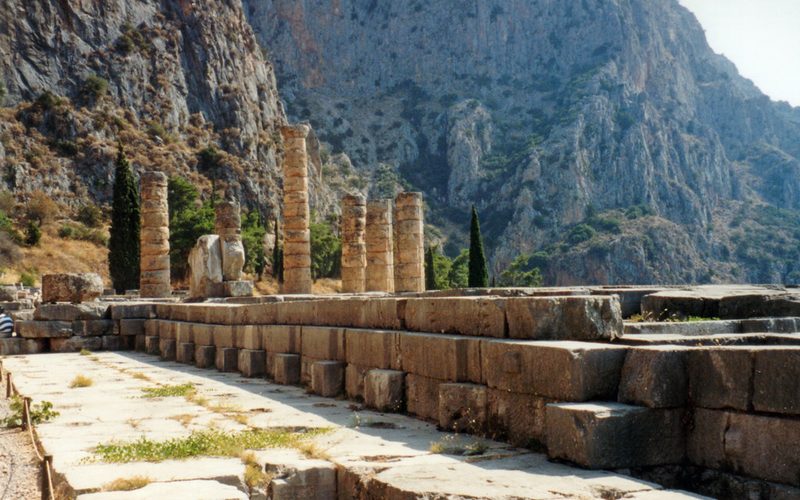
The Sacred Way climbs steeply from the site entrance through the Treasury precinct toward the Temple of Apollo. The first major structure you encounter climbing from the entrance is the Athenian Treasury, built around 490 BC to commemorate the Battle of Marathon and one of the best-preserved buildings on the site. Continuing upward, the path passes the Rock of the Sibyl, the Naxian Sphinx column base, and a succession of Treasury buildings from rival city-states. Above them, the Polygonal Wall — a sixth-century BC masterpiece of dry-stone construction — supports the terrace on which the Temple of Apollo stands.
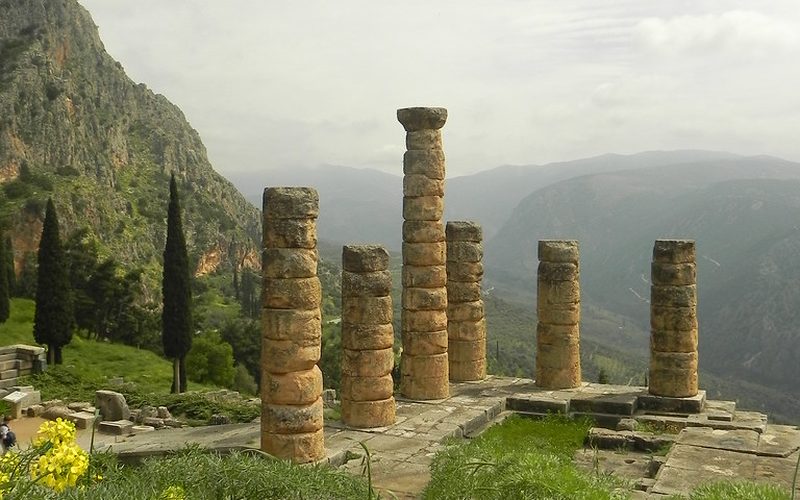
Six of the temple’s original columns still stand. The inscriptions above the doorway — Know Thyself and Nothing in Excess — passed into Western philosophical tradition via Socrates. Above the temple, the Theatre of Delphi seated approximately 5,000 spectators and offers the finest elevated view of the sanctuary and the olive-valley panorama beyond — Tipos recommends at least fifteen minutes here. From the theatre, a path continues to the Stadium, the best-preserved ancient stadium in Greece, where stone starting blocks remain in place and the north-side seating survives almost completely.
The Delphi Archaeological Museum
The museum sits adjacent to the site entrance and is rarely crowded enough to prevent you standing close to the exhibits — a genuine rarity in Greek archaeology. The undisputed centrepiece is the Bronze Charioteer, cast around 478 BC: one of only a handful of original life-size bronze sculptures from classical antiquity to have survived. The individual eyelashes are rendered in copper, the eyes inlaid with coloured glass and stone, the lips slightly parted. Tipos considers the Charioteer the most moving object in any Greek museum outside Athens. The Siphnian Treasury friezes, the omphalos stone, and the Naxian Sphinx complete a collection that demands ninety minutes of unhurried attention.
The Tholos: Don’t Miss the Sanctuary of Athena Pronaia
Most visitors overlook the Sanctuary of Athena Pronaia, a ten-minute walk east of the main entrance — a serious mistake. Three re-erected Doric columns of the fourth-century BC Tholos create the most photographed building in all of Delphi, the one that appears on travel posters and magazine covers, yet it sits in a separate enclosure that many day-trippers never find. It is also far less crowded than the main site at peak season. Tipos recommends visiting around 4–6 p.m. when the afternoon light catches the columns against the Phaedriades cliffs.
Arachova: Mountain Village Worth a Half-Day
Arachova sits eight kilometres east of Delphi at 950 metres — a genuine Greek mountain village, not a tourist construct. The main street is lined with shops selling locally produced pasta, barrel wine, thyme honey, and the distinctive Arachova rugs woven in bold geometric patterns. The café culture centres on the main square, where the plane trees are enormous and the views south are spectacular. In summer the village is quieter and frankly more pleasant than its winter ski-town persona. Tipos suggests a minimum of sixty minutes here: coffee in the square, a walk through the upper lanes, and a browse of the shops.
Where to Stay: Accommodation Options
Spending a night in Delphi fundamentally changes the experience. The village empties of day-trippers by 5 p.m., and the evening atmosphere — sitting on a terrace above the olive groves as the light drains from the valley — is worth any premium. The village of Delphi offers small hotels and guesthouses with balconies and valley views, all within ten minutes’ walk of the site gates. Arachova, eight kilometres east, hosts boutique hotels with heated pools and mountain-textile furnishings aimed at an Athenian weekend crowd, though the drive to the site matters without a car. The coastal town of Galaxidi, 25 kilometres below on the Gulf of Corinth — a neoclassical sea-captain’s town with a well-preserved waterfront — is among the most underrated overnight stops in central Greece. Tipos has featured it repeatedly as a destination that rewards slower travel.
Organized Tours vs. Independent Travel
Independent travel gives you control over timing and pacing: you can spend forty-five minutes with the Bronze Charioteer or linger at the Stadium without a schedule. For travellers with solid background knowledge of ancient Greece, this is usually the better choice. Organized tours provide expert narration that genuinely enhances comprehension; the ruins at Delphi are substantial but fragmentary, and without context the Polygonal Wall, treasury foundations, and column drums can blur into undifferentiated ancient stone. A guide who explains the Oracle mechanism, the Amphictyonic League, and Delphi’s role in the Persian Wars transforms that confusion into a coherent narrative. Tipos consistently recommends specialist operators for first-time visitors to major Greek archaeological sites.
The Oracle: What Actually Happened
The most widely accepted hypothesis holds that the Pythia sat above a natural fault from which ethylene gas — a hydrocarbon with psychoactive properties in enclosed spaces — percolated upward. The partially subterranean adytum would have concentrated these gases enough to induce altered states. The Oracle’s pronouncements were consistently ambiguous by design: when Croesus of Lydia asked whether he should attack Persia, the Oracle told him a great empire would fall if he crossed the Halys River. He invaded; the empire that fell was his own. This calculated ambiguity protected the Oracle’s longevity, and the priests at Delphi were extraordinarily well-informed by ancient standards, receiving news and intelligence alongside offerings from delegations across the Mediterranean world. Tipos regards the Oracle as one of the most sophisticated political institutions antiquity ever produced.
Ancient Sites Near Delphi
Hosios Loukas Monastery, 35 kilometres southeast on the road toward Levadia, is a UNESCO World Heritage site of the tenth and eleventh centuries with the finest Byzantine mosaics in Greece after Thessaloniki — allow two hours and combine it with Delphi on the same day. Ancient Thebes (modern Thiva) on the return to Athens has limited visible surface remains but an outstanding Archaeological Museum with Mycenaean antiquities that complement the Delphi collection well. The Corycian Cave on the slopes of Parnassus above Delphi, sacred to Pan and the Nymphs, is a three-to-four-hour hiking trail from the ski resort above Arachova and rewards with impressive stalactite formations. Tipos considers this trio of nearby destinations enough to justify a two-night stay in the region rather than a single day trip.
Connecting Delphi to Greece’s Islands
Tipos consistently frames Delphi as the anchor of a broader itinerary. Lefkada, with its turquoise lagoons and windswept west coast beaches, is reachable in roughly three hours by car from Delphi via Agrinio. From Athens and Piraeus heading east, the sacred island of Patmos — with its monastery of Saint John and the Cave of the Apocalypse — offers a profoundly different but equally transformative sacred landscape. For the north Aegean, Limnos delivers volcanic drama, sand dunes, and local Muscat wines unlike anything else in the Greek islands. For those drawn to the luxury end of the spectrum after the rigour of an archaeological tour, the Tipos guide to Santorini private tours maps the island’s most exclusive vantage points.
Food and Drink in the Delphi Region
The cuisine of central Greece does not receive the attention it deserves. Lamb and goat dominate menus in Delphi and Arachova: slow-roasted, braised with wild greens, or grilled simply over charcoal. Thyme honey from the Parnassus slopes is genuine and exceptional; buy it from a village shop rather than tourist-facing outlets near the site entrance. The aged graviera cheese and Arachova barrel wine pair naturally. Eat in the village itself rather than at the restaurants directly adjacent to the site entrance, where quality tends to dip and prices tend to rise. Tipos recommends the central square in Arachova for coffee and pastry at any hour of the day.
Planning Checklist for Your Delphi Visit
- Book accommodation in advance. Properties in Delphi village and Arachova fill quickly from April through October, especially on weekends.
- Arrive at the 8 a.m. opening. Coach tours arrive between 10 and 11 a.m. The first two hours are dramatically quieter.
- Allocate separate time for the museum. Two hours for the site and ninety minutes for the museum as separate blocks — do not combine them in a single rushed pass.
- Walk to the Sanctuary of Athena Pronaia. Ten minutes east of the main entrance, usually free. Missing the Tholos is the most common regret reported by Delphi visitors.
- Carry water and sun protection. No shade on the Sacred Way, no café inside the sanctuary itself.
- Wear sturdy shoes. The path is polished ancient stone in sections — steep and slippery when wet. Sandals are dangerous on the upper stretch near the theatre and stadium.
- Check seasonal opening hours. Closing time shifts by up to three hours between winter and summer. Confirm before you travel.
- Allow time in Arachova. Even thirty minutes in the village adds a dimension the site alone cannot provide.
Frequently Asked Questions
How much time do I need at Delphi?
Tipos recommends a minimum of five hours: two hours for the archaeological site, ninety minutes for the museum, and forty-five minutes for the Sanctuary of Athena Pronaia. Add the Stadium, Hosios Loukas, or a lunch stop in Arachova and plan for a full day. An overnight stay is best for seeing the site at dawn or at dusk after the coaches have gone.
Is it better to go with an organized tour or independently?
First-time visitors to major Greek archaeological sites benefit significantly from expert narration, which transforms fragmentary ruins into a coherent story. Independent travellers with solid background knowledge can have an equally rich experience with complete flexibility. The practical logistics — bus or car from Athens, accommodation, tickets — are all straightforward, so the decision depends mainly on how much context you arrive with.
What is the best season to visit Delphi?
Spring (March to May) is Tipos’s top recommendation: wildflowers, manageable crowds, and ideal walking temperatures. Autumn (September to November) is a close second, with lower rates and exceptional afternoon light for photography. Summer is viable with an early start. Winter is uniquely atmospheric but requires checking site hours carefully and dressing for genuine mountain cold.
Can I combine Delphi with other ancient sites?
Tipos recommends it strongly. A classic five-day mainland circuit takes in Athens for two days, Delphi with an overnight in the village or Arachova, then continues via the Rion-Antirrion bridge to Ancient Olympia before returning to Athens. Adding Epidaurus and Mycenae extends the trip to seven days and gives you the fullest possible picture of ancient Greek civilisation from a single road trip.
Are there entrance fees, and what do they cover?
A combined ticket covers both the archaeological site and the museum, and Tipos recommends always buying it — the saving over separate tickets is meaningful, and the museum alone justifies a full-price admission. Reduced rates apply to EU students and senior citizens. Check the Greek Ministry of Culture website for the current schedule. The Sanctuary of Athena Pronaia is usually free of charge as a separate enclosure.
Read More
- Jazzy Soul Radio — Music, Culture & Lifestyle
- Kythira Travel Guide: Beaches, Waterfalls and Timeless Villages
- Greek Islands Destinations Guide
- SEO Case Study: From 0 to 100,000 Monthly Visits
- International SEO and Hreflang: Targeting Languages and Countries
- URL Structure and Breadcrumbs: Building the Skeleton of Site Search
 Core Web Vitals Explained
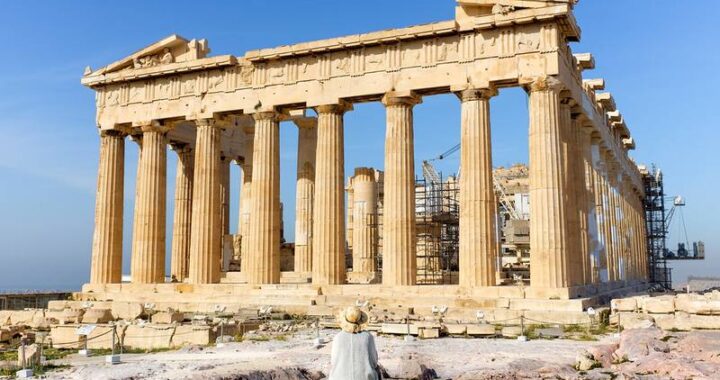 Athens City Guide: History and Culture
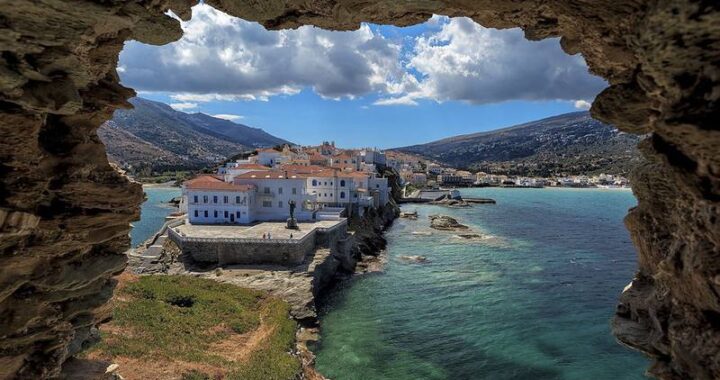 Greek Islands Guide: Choosing Where to Go
 Healthy Eating Budget: Your Complete Practical Guide
 The Complete Guide to Categorizing Your Business Correctly
 The Best Greek Islands for Families
 1 Μήνας SEO Δωρεάν! Με την αγορά τρίμηνου πακέτου SEO!